
Across operating utility-scale BESS assets, a significant share of performance losses and operational risks does not originate from major failures, but from everyday anomalies that remain undetected or poorly understood.
As shown in our analysis of operating assets ‘The True Cost of BESS Anomalies’, the cumulative impact of these issues can represent close to 10% annual revenue loss, driven by a combination of gradual degradation effects and intermittent availability losses.
These anomalies often emerge progressively and remain below the thresholds of traditional monitoring systems, raising a fundamental challenge:
Why is battery behavior still so difficult to model accurately in real-world conditions?
1. Introduction
In the context of massive electrification, understanding and predicting battery behavior has become a critical challenge, not only from a technical standpoint, but from an operational and economic perspective.
Despite the increasing availability of data and advances in artificial intelligence, accurately modeling battery systems in real-world conditions remains difficult. This is due to the combination of complex electrochemical phenomena that cannot be captured through data alone, heterogeneous system behavior, and evolving operating conditions across assets.
This has led to the widespread adoption of two main modeling approaches:
- physics-based models
- data-driven models based on artificial intelligence (AI)
While each approach brings important capabilities, their limitations become apparent when applied in isolation.
These challenges are common across both stationary battery energy storage systems (BESS) and electric vehicle (EV) battery fleets, where variability in usage, environment, and aging further complicates accurate modeling.
To better understand these challenges, it is useful to examine the two dominant modeling approaches used today.
2. Physics-Based Models: Essential but Incomplete
Physics-based models rely on the description of the underlying electrochemical phenomena within the battery (ionic diffusion, electrode reactions, charge transport, thermal behavior, etc.).
A widely used approach consists of modeling batteries using Equivalent Circuit Models (ECMs), which provide a good trade-off between accuracy and computational complexity when describing voltage and thermal behavior.
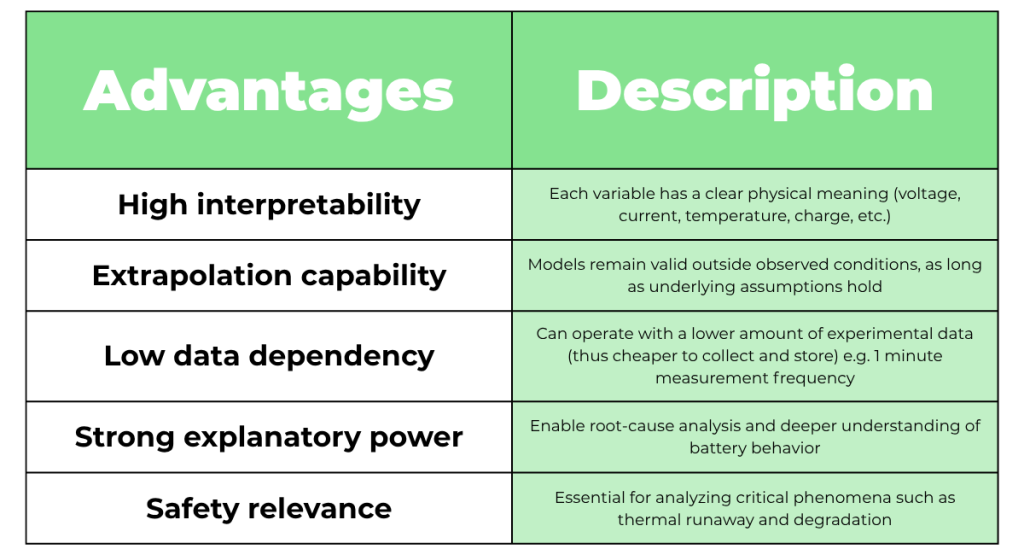
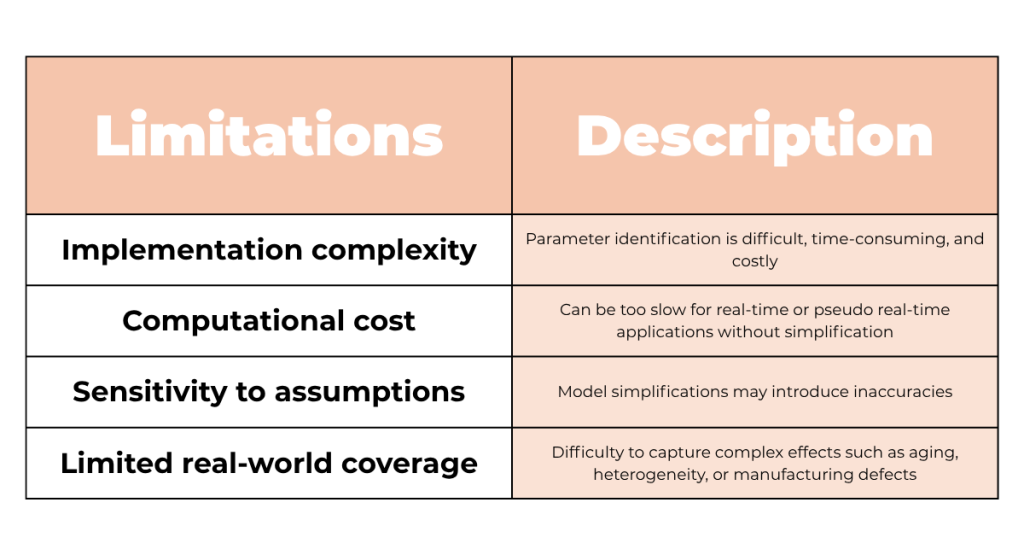
Their advantages and limitations are described below.