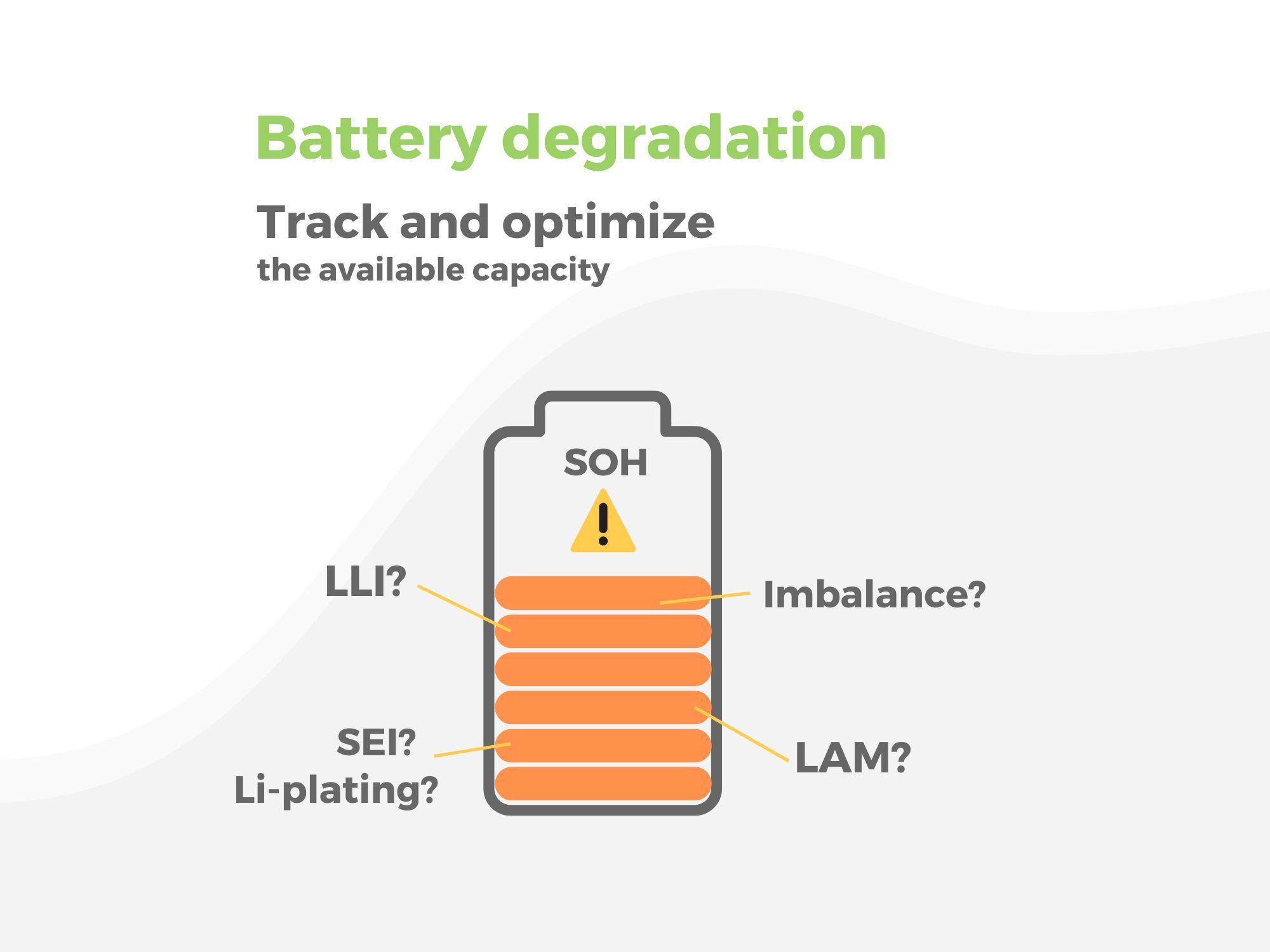

Across operating utility-scale BESS assets, a significant share of performance losses and operational risks does not originate from major failures, but from everyday anomalies that remain undetected or poorly understood.
As shown in our analysis of operating assets ‘The True Cost of BESS Anomalies’, the cumulative impact of these issues can represent close to 10% annual revenue loss, driven by a combination of gradual degradation effects and intermittent availability losses.
These anomalies often emerge progressively and remain below the thresholds of traditional monitoring systems, raising a fundamental challenge:
Why is battery behavior still so difficult to model accurately in real-world conditions?
1. Introduction
In the context of massive electrification, understanding and predicting battery behavior has become a critical challenge, not only from a technical standpoint, but from an operational and economic perspective.
Despite the increasing availability of data and advances in artificial intelligence, accurately modeling battery systems in real-world conditions remains difficult. This is due to the combination of complex electrochemical phenomena that cannot be captured through data alone, heterogeneous system behavior, and evolving operating conditions across assets.
This has led to the widespread adoption of two main modeling approaches:
- physics-based models
- data-driven models based on artificial intelligence (AI)
While each approach brings important capabilities, their limitations become apparent when applied in isolation.
These challenges are common across both stationary battery energy storage systems (BESS) and electric vehicle (EV) battery fleets, where variability in usage, environment, and aging further complicates accurate modeling.
To better understand these challenges, it is useful to examine the two dominant modeling approaches used today.
2. Physics-Based Models: Essential but Incomplete
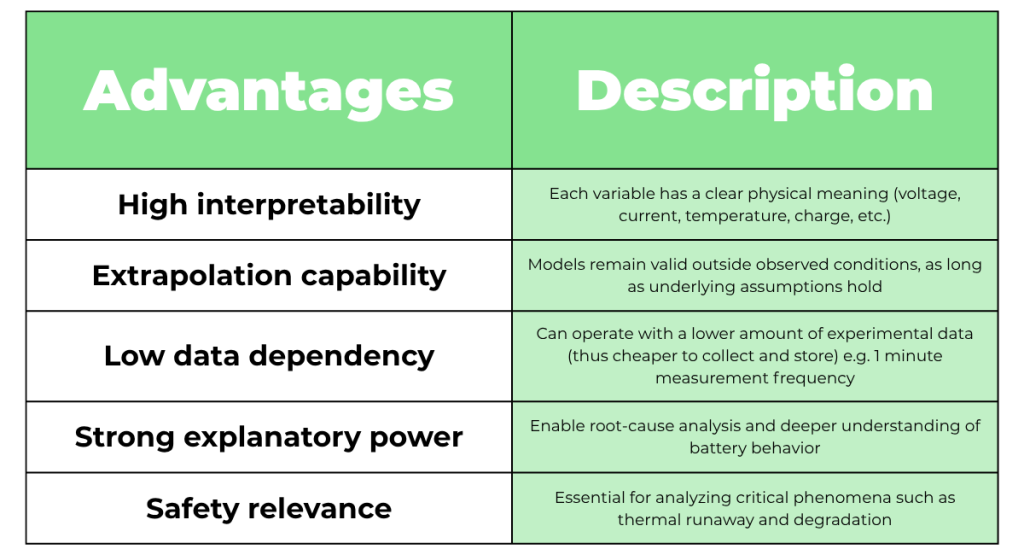
Physics-based models rely on the description of the underlying electrochemical phenomena within the battery (ionic diffusion, electrode reactions, charge transport, thermal behavior, etc.).
A widely used approach consists of modeling batteries using Equivalent Circuit Models (ECMs), which provide a good trade-off between accuracy and computational complexity when describing voltage and thermal behavior.
Their advantages and limitations are described below.
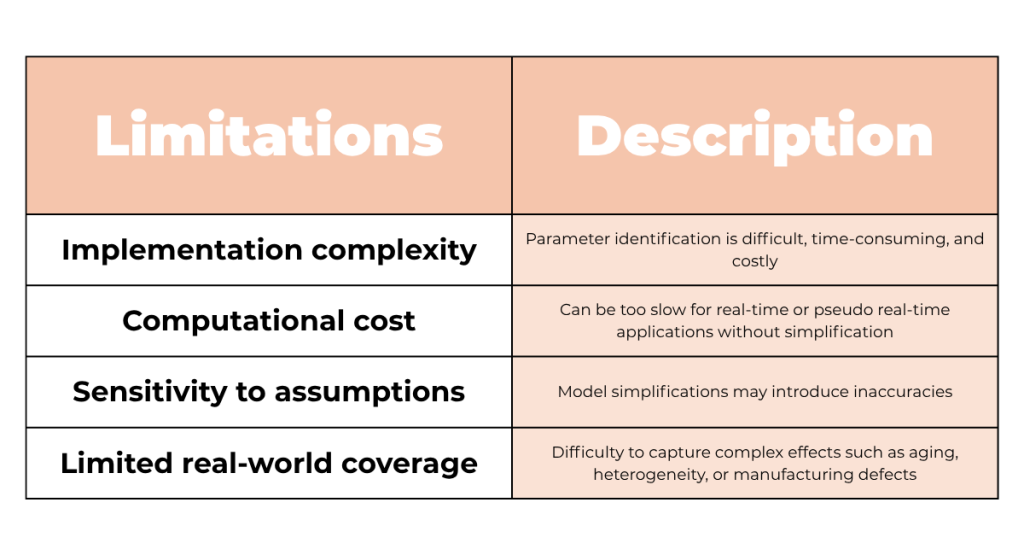
As a result, purely physics-based approaches often struggle to remain accurate and scalable when confronted with the variability and complexity of real-world operating data.
3. AI-Based Models: Powerful but Fundamentally Limited
AI-based models learn directly from data (current, voltage, temperature measurements, usage history, etc.) to predict KPIs.
Their advantages and limitations are described below.
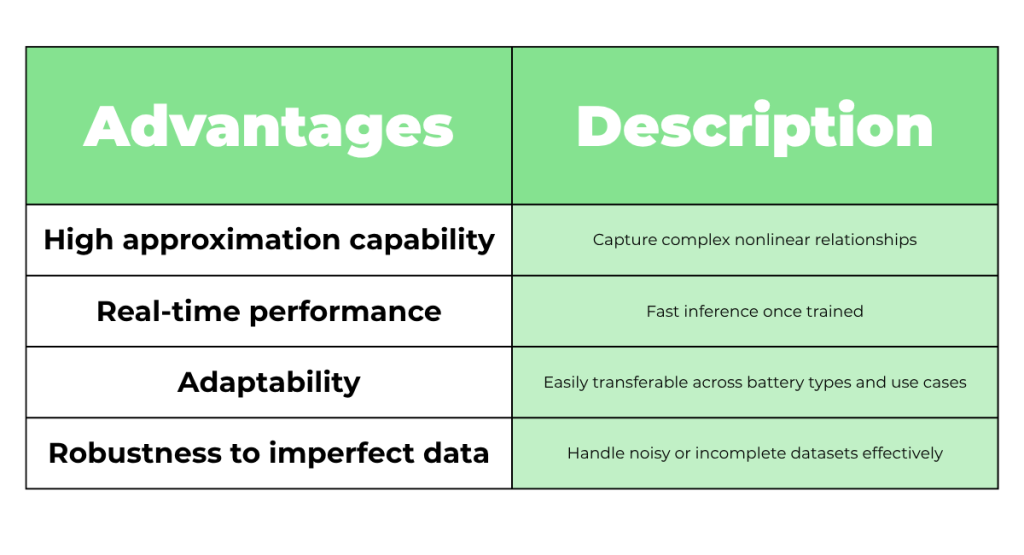
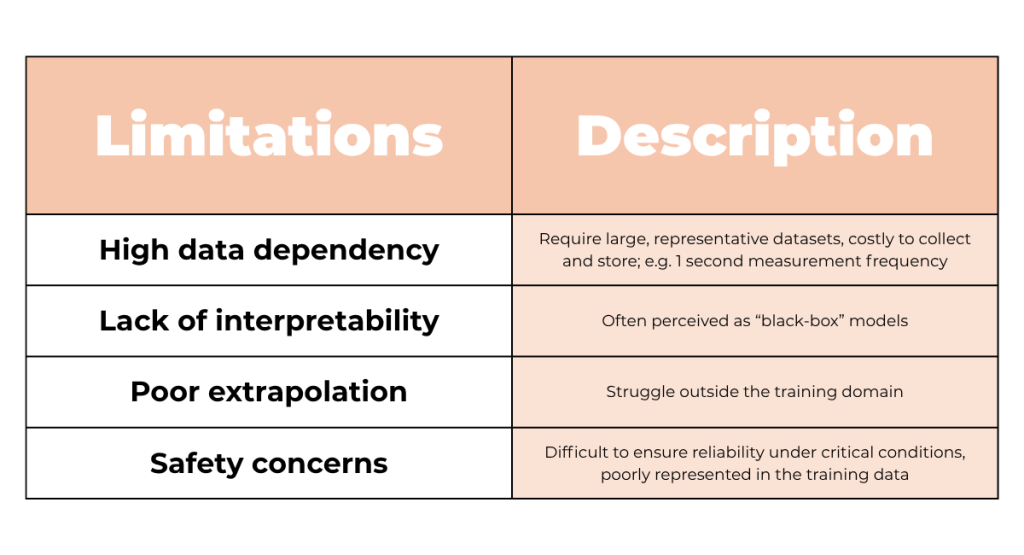
In practice, AI-only approaches may perform well under known conditions but become unreliable when faced with new environments, aging effects, or rare but critical events—particularly when they are not grounded in electrochemical principles.
4. Physics-Informed AI: Bridging Models and Reality
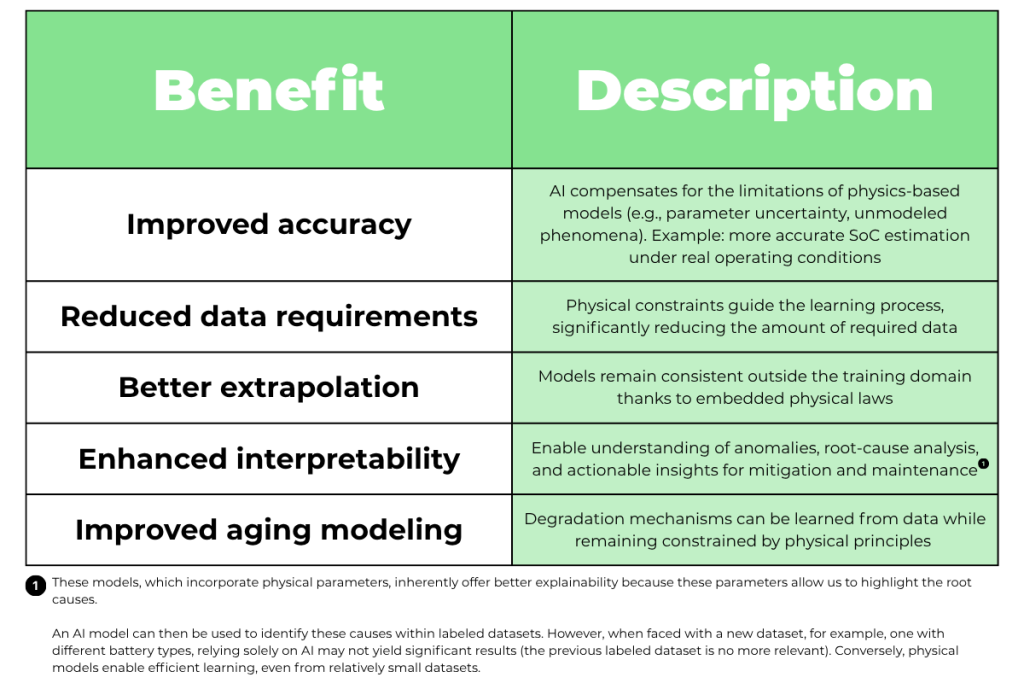
Real-world deployments consistently highlight the same conclusion: combining physics and AI is not optional, but necessary.
- Physics-based models provide physical consistency and interpretability.
- AI enables adaptation to real-world data and complex system behavior.
This convergence has led to the emergence of Physics-Informed Artificial Intelligence approaches.
This complementarity is not just theoretical; it directly translates into measurable operational benefits.
5. From Physics to AI: The Role of Transfer Learning
In practice, the integration between physics-based models and AI is not only conceptual: it is operational. One of the key mechanisms enabling this interaction is transfer learning.
Hybrid modeling approaches often follow a three-step process:
1. Physics-Based Pre-Training
Physical models and laboratory data are used to generate structured, high-quality datasets that reflect known electrochemical behaviors.
2. Knowledge Transfer
AI models are initialized using this physically grounded data, allowing them to encode key constraints such as expected voltage response, thermal dynamics, and degradation trends.
3. Real-World Fine-Tuning
The model is then adapted using operational data, enabling it to capture site-specific effects, measurement noise, and previously unmodeled phenomena, while remaining consistent with electrochemical principles.
This approach provides a critical advantage: the model does not learn from scratch, but starts from a physically meaningful foundation and refines it based on real-world observations.
As a result, transfer learning significantly reduces data requirements, improves robustness, and enables faster deployment across assets.
Importantly, this process relies on accurate electrochemical modeling and validated laboratory data. Without this foundation, data-driven models risk learning misleading correlations rather than true battery behavior, limiting their reliability in real-world conditions.
6. Use Case
A concrete example illustrates how this hybrid approach performs in real-world conditions: PowerUp has developed a thermal digital twin using an electro-thermal model coupled with machine learning. This approach combines physical modeling with continuous data-driven calibration, enabling detection of early signs of thermal management issues.
In stationary storage systems (BESS), thermal anomalies are frequent and can:
- accelerate aging
- degrade performance
- trigger safety shutdowns and create safety risks
The hybrid model approach enables:
- early detection of thermal anomalies before they impact availability or safety
- continuous adaptation to real operating conditions
- reduced data requirements, with approximately two weeks of operation sufficient to initialize the model.
This example illustrates a key requirement for advanced battery analytics: combining physically grounded models, real-world data adaptation, and scalable deployment.
Such approaches cannot be built from data alone: they require deep electrochemical expertise and validated laboratory testing to ensure reliability across operating conditions.
For more information, refer to: Safeguarding Battery Storage: AI-Driven HVAC Anomaly Detection – PowerUp.
7. Conclusion
As battery systems continue to scale in size, complexity, and economic importance, the limitations of purely data-driven or purely physics-based approaches become increasingly apparent.
Best-in-class battery analytics are not defined by AI capabilities alone, but by the ability to integrate physics, data, and real-world validation into a unified modeling framework.
Hybrid approaches, commonly referred to as Physics-Informed Artificial Intelligence, represent a critical step in this direction, enabling more accurate, interpretable, and operationally relevant insights.
Ultimately, this convergence is essential to improving performance, safety, and lifetime of Li-ion batteries across both stationary storage systems and electric mobility applications.