
By Guillaume Mazade, EMEA Sales Manager
The Gulf has moved faster than many anticipated. The UAE is building what Masdar call the world’s largest battery project, 19 GWh at a single site in Abu Dhabi, ACWA Power’s aggregated Battery Energy Storage Systems (BESS) capacity stands at 5.6 GWh in operation, but it is backed by an explosive multi-gigawatt-hour pipeline, and Saudi Arabia’s SPPC is tendering gigawatt-hour rounds of storage on 15-year contracts. I cover EMEA, so I talk with owners, operators, integrators, and asset managers here often, and the conversation has already moved from whether these fleets get built to what happens once they are running.
The Middle East storage market is entering a new phase where the key challenge is now proving they will deliver contracted performance over time.
In an availability-based market, every hidden MWh becomes a potential revenue gap.
Most of the region’s storage earns through long-term contracts with a state offtaker, paid for keeping capacity available rather than by trading a merchant market. So, performance is the business model. You earn by being available and delivering the capacity you committed to, day after day. When you cannot, you miss the availability targets those payments depend on, and the gap between the capacity you promised and the capacity you actually deliver shows up in your availability numbers first, then in your revenue.
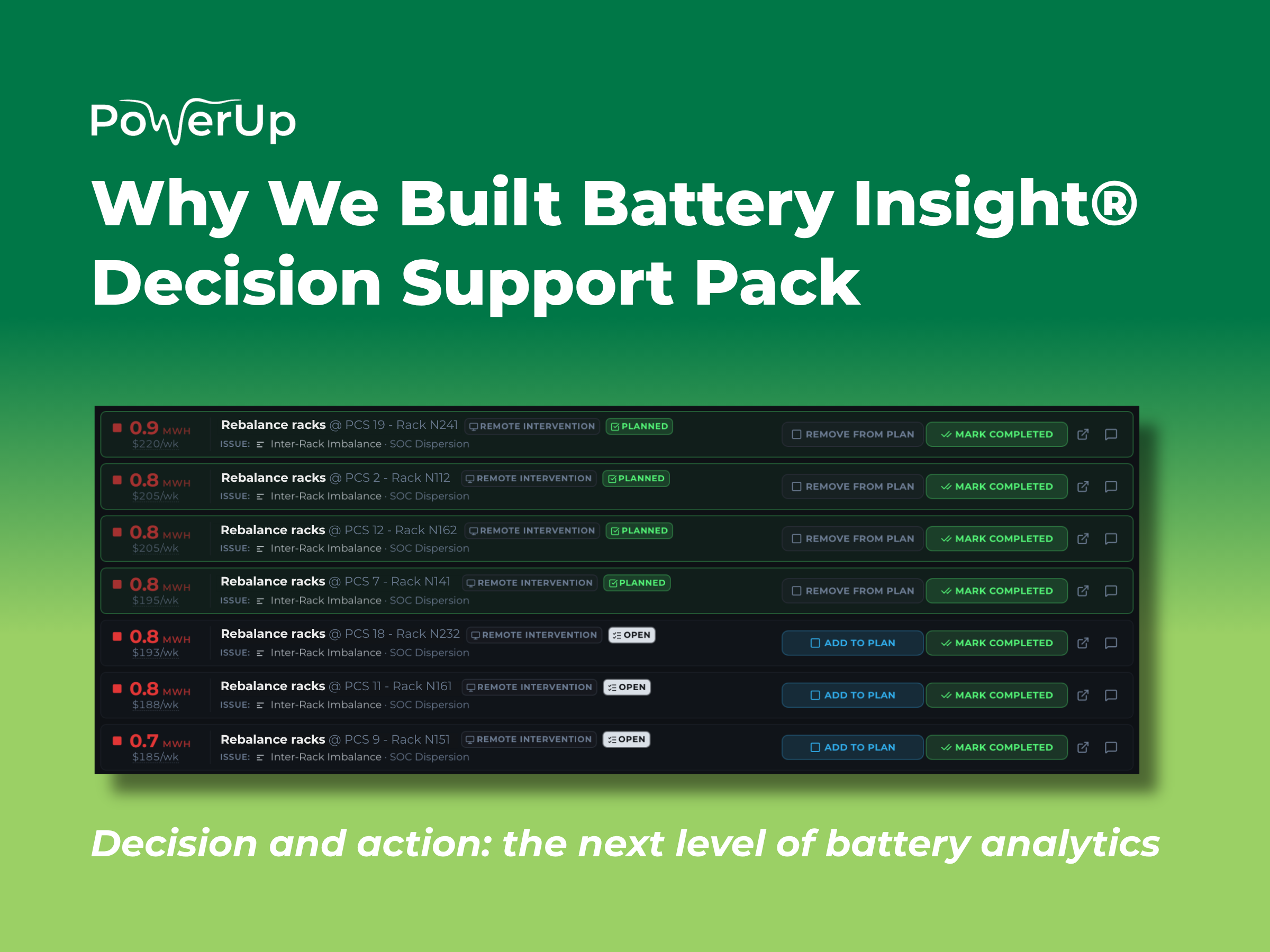
This is the part that catches teams off guard. An asset can look healthy on every standard dashboard and still hold back energy it is contracted to deliver. Racks that pass their checks underperform. Imbalance across racks strands capacity. Most of it never trips an alarm, because alarms are built to catch faults, and the slow erosion of the capacity you are paid for goes unnoticed.
The financing side is watching the same thing from the other direction. As the region works to bring private capital into its next phase, asset managers and infrastructure investors keep returning to two questions:
- How fast will these batteries degrade?
- Will they hold up at scale over a 15-year contract?
It is the same shift already reshaping how storage gets financed elsewhere, where bankability is moving from installed capacity to proven operational performance. An owner who can answer both with early, credible evidence is in a much stronger position than one still pointing to nameplate specifications.
All of this plays out in one of the hardest environments on earth for a battery. Constant heat and dust push thermal management to its limit, and thermal trouble usually shows up as a signal before it becomes a shutdown. In one case our team analyzed, a temperature drift ran for ten days before the system tripped. I have not run a battery in that kind of heat myself, but we see what it does in the data, and the region’s early projects are where the industry is learning to read those signals in time. It is no surprise that lessons from early projects and safety in intense climates are on the agenda in Dubai this year.
The owners who come out ahead will be the ones who can see what their assets are actually doing, early enough to act, using the systems and partners they have already committed to on projects of this size. The job is to make that existing stack tell them what matters, what to do, and why, rather than replace it, and to catch it before the availability report does.
That is the work we do at PowerUp. Battery Insight® runs on the operational data these fleets already produce, applies electrochemistry and data science to it, and surfaces the early signs of drift, imbalance, and thermal stress that cost availability. It augments the existing stack rather than competing with it. When availability is what you get paid for, identifying performance drift before it impacts contractual availability helps protect both revenue and asset value.
How are you validating that your assets will still deliver contracted performance in year 10 or year 15?
I do not think the industry has fully answered that yet, and it is what I want to discuss most at Energy Storage Summit Middle East in Dubai, September 1 to 3. I am going to listen more than talk. If you own, operate, or finance storage in the region, I would like to hear how you are thinking about performance as these fleets scale.