
By Guillaume Mazade, EMEA Sales Manager
At Energy Storage Summit Middle East in Dubai, on a panel about where the industry should invest to improve long-term BESS performance, the moderator asked the panelists who own and run storage in the region a simple question:
If you had five percent more CapEx on your next project, where would you put it?
I expected to hear multiple answers for bigger inverters or a longer warranty. Instead, the majority said the same thing: battery analytics.
They said they want to understand how their batteries age depending on how the assets are actually being used. One of the panelists added that better analytics would improve operational strategy, increase revenue, and reduce maintenance costs. Another said thermal management so they can control the risk of premature aging from the very high temperatures the region deals with every summer.
Both answers come back to the same concern: how the battery ages from real operation compared to the design assumptions.
The Battery You Designed Is Not the Battery You End Up Running
The moderator also asked what worried the panelists most about the lifetime of their BESS, and their answers made it clear why analytics and thermal management were where they would put the money.
Storage is designed against a theoretical operating profile: cycles per day, depth of discharge, charge and discharge rates, resting SoC, and temperature. The OEM’s degradation curve, the warranty, and the financial model all inherit that profile. It is the best assumption available at the design stage. But once the asset is in service, the market, the offtaker, and the weather decide how it actually runs, and every one of those parameters starts to shift.
One panelist said they need models that show how the real profile affects the lifetime of the asset. Another made the same point from the revenue side: capturing maximum revenue means optimizing the operating strategy, and you cannot do that without understanding how the battery ages under the actual operating and cycling profile.
In an availability market, that matters more than it does elsewhere. I wrote before the summit that in the Gulf, availability is the revenue: most assets here are paid for delivering contracted capacity day after day, and a hidden shortfall shows up in the availability report before anyone understands why. The panel was covering the next question: once the asset is delivering, how long does it keep delivering? That is a question about aging, and aging follows the profile the battery actually experiences.
What Thermal Management and Analytics Have in Common
Batteries age in two broad ways:
- Calendar aging comes from time spent at high state of charge and high temperature, whether or not the asset is cycling.
- Cycle aging comes from depth of discharge, current rate, and temperature during cycling.
Heat drives both. The panelist who wanted thermal management and the ones who wanted analytics were describing the same lever from two sides: one wanted to control the temperature the cells see, and the others wanted to know what temperature, and everything else in the operating history, was doing to remaining useful life.
Heat is the factor the region can least control, and a cooling unit drifting out of range can run for days before a temperature threshold catches it.
In an analysis our team published in the 2026 kWh Analytics Solar Risk Assessment across 8 utility-scale sites totalling 596 MWh and 149 containers, in a range of climates, 75% of sites experienced at least one HVAC-related thermal anomaly and 21% of containers were affected. Seventy percent of those anomalies lasted more than one day, and some ran for as long as 43 days. In one case, a temperature drift ran for ten days before the system tripped. The protection worked as designed, but the real question here is what those ten days did to the cells’ lifetime, and whether anyone knew it was happening.
None of those sites were in the Gulf.
If an HVAC unit drifting for a week costs a site with mild ambient temperatures a measurable slice of lifetime, can you imagine the cost at 45°C?
Where Does the Five Percent Actually Go?
Thermal management that holds cells inside their intended envelope slows both kinds of aging, but it only addresses heat. Analytics reads the operating history against the capacity trend and shows which factor is doing the damage on a given site. A plant aging from long periods at high SoC has an operational fix; a plant aging from cycle depth has a dispatch strategy fix. And a plant with an HVAC unit that has been drifting for a week has a maintenance ticket that should have gone out on day two.
The same operating history also tells you whether the asset is still inside the operating conditions the warranty assumes, which is worth knowing before the OEM points it out.
That is why the panel put the five percent into analytics and thermal management rather than into more battery. Oversizing covers the degradation you planned for, but analytics tells you about the degradation you did not.
What This Looks Like in Practice
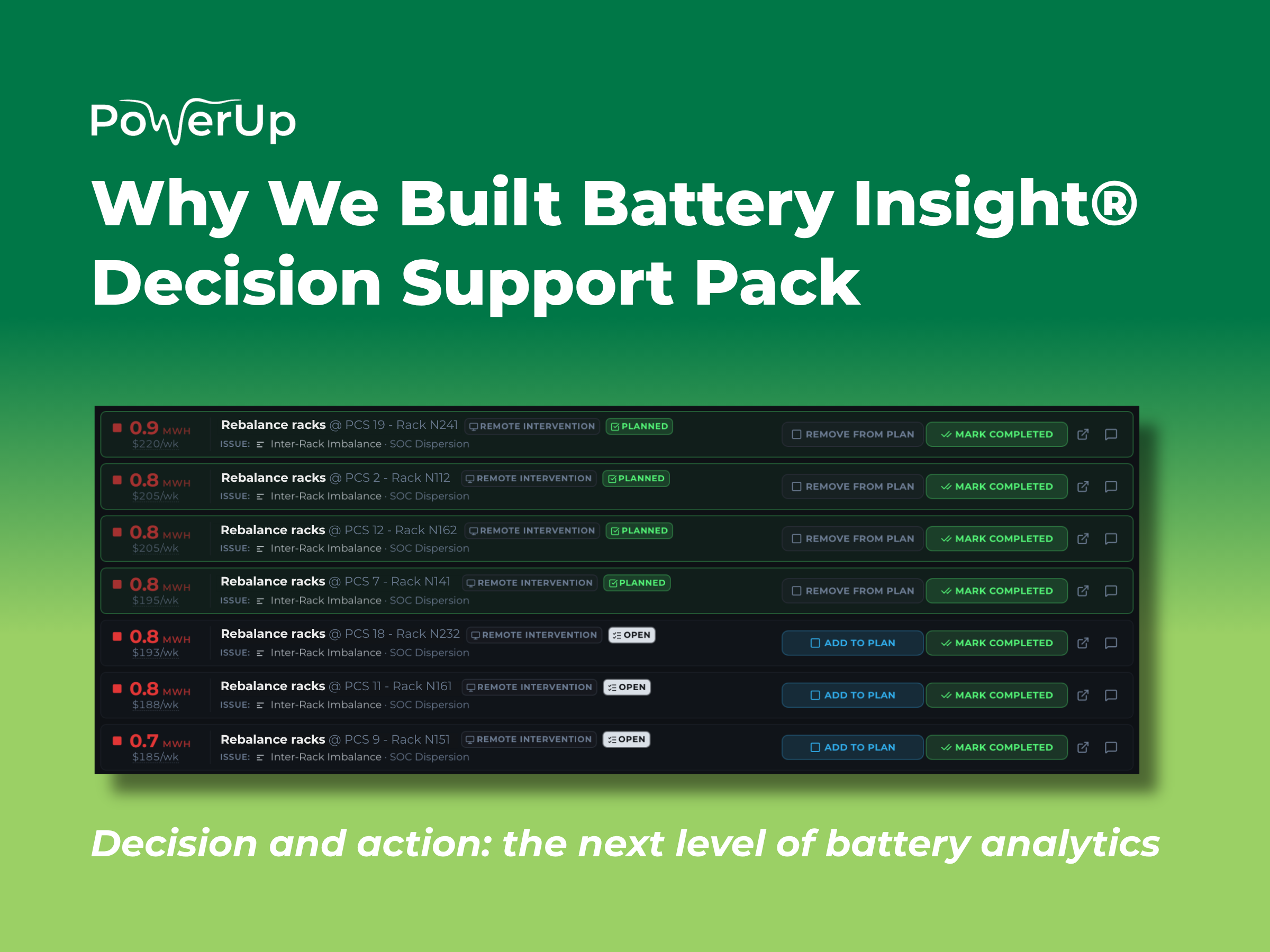
Battery Insight® works from the operational data these fleets already generate and applies electrochemistry and data science to it. It surfaces thermal deviations days or weeks before safety thresholds are reached, tracks how the operating profile diverges from design assumptions, and helps an asset manager see which aging factor is doing the damage. It works upstream of the BMS and EMS and alongside the site’s thermal management.
In the Gulf, most utility-scale storage runs on a 15-year contract with a state offtaker. That is a long time to be accountable for performance, and the owners who do well over that term are the ones who can answer this question: how fast will these batteries degrade, and what are you doing about it? Real operating data answers that question with a confidence a design curve cannot provide.
If you own, operate, or finance storage in the Gulf and are working through the same question, I would like to hear how you are answering it.