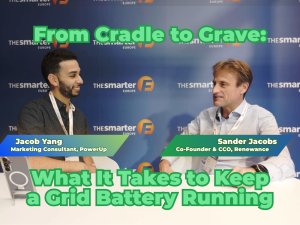
In our article featured on Energy Storage News, The State of BESS Analytics: Three Views from The Smarter E 2026, we argued that battery analytics has crossed from a simple monitoring tool into a decision layer for energy storage. This piece looks at it from the integrator’s side. At The Smarter E 2026, Jean-Marc Guillou, Business Unit Director at Socomec, sat down with Jacob Yang, Marketing Consultant at PowerUp, to explain why a company that has to stand behind a system for a decade or two needs more than the readings a battery reports about itself.
Socomec’s Market: Behind-the-Meter
Backing an asset for that long starts with a deliberate choice about where to compete. Energy storage splits into two markets. Front-of-the-meter covers large, grid-scale projects, often above 500 MWh, and Jean-Marc was clear that this is not where Socomec plays. The company works behind the meter, in the commercial and industrial (C&I) segment, where the battery serves a customer’s own operation rather than the wholesale grid. Their customers are independent power producers and large industrial sites adding solar and storage to run greener, and Socomec’s job is to hand each of them an asset that performs for the long haul.
Why Raw Readings Aren’t Enough
Socomec is both a manufacturer and a software provider, and the two roles meet in one requirement: when a customer takes delivery, they expect the system to operate for ten, fifteen, or twenty years. An energy management system (EMS) decides when to charge and discharge, and those decisions are only as good as its read of the battery underneath. The difficulty, as Jean-Marc put it, is being confident that read reflects what is actually happening inside.
“We have to believe in the data provided by the batteries.” – Jean-Marc Guillou, Business Unit Director, Socomec
A battery management system (BMS) reports voltage and temperature from physical measurements, and it does that job well. What those raw measurements do not directly give you is a confident read of the battery’s true condition. That is the step Socomec fills with battery data analytics, Battery Insight®, by PowerUp. The analytics turn the measurements into state-of-charge (SOC) and state-of-health (SOH) within a tighter error band, help catch safety risks early, and produce a lifetime estimate the company can actually warranty. Even with the safer LFP chemistry Socomec favors, a battery sitting next to a commercial or industrial operation is a risk to manage rather than assume away.
From Add-On to Standard
Historically, C&I operators who wanted this kind of visibility had to seek it out and add it themselves. Socomec changed that by building PowerUp’s analytics into every new BESS it sells, delivered through its SoLive Pro BESS monitoring platform as part of five years of standard monitoring. Where conventional monitoring reports real-time status and alarms, the embedded analytics apply algorithms to live and historical data to surface early signs of degradation, including SOH, remaining useful lifetime (RUL), and cell imbalance that sit outside what a BMS is designed to capture.
By Socomec’s own estimate, that visibility can extend battery lifetime by up to 20%, improve availability by three to five percent a year, and free up to 15% additional usable capacity, which can translate into two to three more years of operation or savings of up to €230,000 per MWh across an asset’s life.
Keeping Pace with a Moving Target
The hardest part of the job, Jean-Marc said, is keeping up with how fast batteries change. New solutions arrive roughly every six months, much of the innovation coming out of Asia, with new chemistries such as sodium-ion and long-duration formats landing alongside LFP, and power conversion shifting toward silicon carbide. An integrator has to absorb all of that without rebuilding its platform each time, which is why Socomec keeps its software stack agnostic to the specific battery and power conversion system (PCS) underneath.
The same discipline pays off later in an asset’s life. As battery costs fall, owners often augment a site, pairing second-life batteries with newer cells, and that only works if someone can analyze how the existing system is actually operating before adding to it. Analytics is what makes a retrofit a measured decision rather than a guess.
Owning the Stack
Anything connected to the grid carries cyber risk, and in Europe the Cybersecurity Act raises the bar for the security an energy storage system must demonstrate. Rather than outsource that exposure, Socomec built its own software, IoT platform, and cloud, storing data on an ISO 27001-certified sovereign French cloud, so it controls the full path from the equipment to the grid connection. For a manufacturer whose systems sit on critical sites, owning that chain is how it manages risk for both the customer and the grid operator.
The Case to a C&I Owner
Taken together, that is Socomec’s case to a C&I owner: hardware and software from one manufacturer, PowerUp’s advanced analytics reading the battery’s true condition, a stack it secures end to end, and fifteen years and more than five hundred deployed sites behind it. Behind all of it is a family-owned manufacturer more than a century old, in business far longer than any warranty it writes. The result is a system an owner can trust to behave the way the contract says it will, with the data to prove it.
Watch the full conversation with Jean-Marc Guillou, Business Unit Director at Socomec, and Jacob Yang, Marketing Consultant at PowerUp.